Disclosure: This post may contain affiliate links, meaning I get commission if you decide to make a purchase through my links, at no cost to you. Please read my Affiliate Disclosure for more information.
If you’ve ever stood in the garden mentally rearranging pots, borders and imaginary raised beds while thinking “Is this even realistic?” – you’re in good company.
This post isn’t about squeezing every last stem out of your space or building the perfect cutting garden. It’s about expectation‑setting. About what’s enough to enjoy flowers, regularly, without the whole thing becoming another job.
Because a summer‑long supply of flowers doesn’t come from optimisation. It comes from choosing a layout – and plants – that quietly support you.
The best cutting garden layout (and why it’s not one-size-fits-all)
If you’ve arrived here asking “What’s the best cutting garden layout?” you deserve a clear answer.
Three questions. Two minutes. A flower list chosen for your actual garden, not some idealised one.
Let’s find your flowers.

For most home growers, the best layout is one that makes cutting feel easy, regular and guilt‑free – and that usually matters more than the exact shape of the beds.
In practical terms, that tends to look like one of two approaches:
- A small, dedicated cutting patch, planted densely and organised purely for harvesting. This is often the easiest option to maintain and cut from because everything in that space exists to be picked.
- Cut flowers grown through the main garden, in borders, pots and among shrubs – which works just as well if you decide in advance that these plants are for cutting too.
Most cutting gardens, whatever their size, work best when plants are grown in blocks rather, whether they are in long rows or not, and when the patch is easy to reach, close to water and somewhere that is easily accessible.
But layout isn’t only about shape and organisation. Where the garden sits matters just as much – often more – than how big it is.
Before settling on size, it’s worth pausing to look at the conditions you’re working with, because they will quietly determine what you can grow and how hard you’ll have to work for flowers.
- Light is the biggest factor. Most annual cut flowers want sun – ideally six hours or more during the growing season. But for that you will be rewarded with productive plants with many flowers per plant. That abundance comes at a cost though. Annuals mean you’re raising plants every year, often over many months, with results that depend on weather, timing and a fair bit of luck. They’re generous, but fleeting – and they place ongoing demands on your soil through regular feeding, mulching and composting. If your available space is in part shade, perennials start to earn their keep. Some cope happily with less light and, once established, they quietly take on more of the work. I’m only just appreciating this myself. Over time, they carry the backbone of the garden and reduce the pressure to be constantly sowing and replacing. The trade‑off is sameness. Perennials return year after year, so you need to genuinely like what they give you. Many gardeners find a middle ground works best: perennials providing structure and reliability, with a smaller cast of annuals changing the mood of the season. Very few plants – annual or perennial – truly thrive in full shade, so if that’s what you’re working with, expectations (and plant choices) need adjusting rather than more space (unless you can find some with more sun!).
- Shelter matters more than we often realise. Windy sites can quickly undo all your careful spacing and staking. A lightly sheltered spot – softened with hedging or trellis rather than a solid wall – makes a noticeable difference.
- Soil and drainage affect productivity far more than neat layout ever will. Free‑draining soil is ideal, but even heavy or imperfect soil can be improved quickly with a no‑dig approach and regular compost mulching.
- Access is part of layout too. A patch close to water, compost and your usual garden routes is far more likely to be cut from regularly. Beds around 1.2m wide gives easy access to the middle of the bed to make cutting easier. Anything wider might encourage having to step on the bed, which is not really ideal.
All of these factors shape what’s realistic in your space.
Once you understand the conditions you’re working with, the more useful question becomes:
What layout – and how much space – is enough to support the results you actually want?
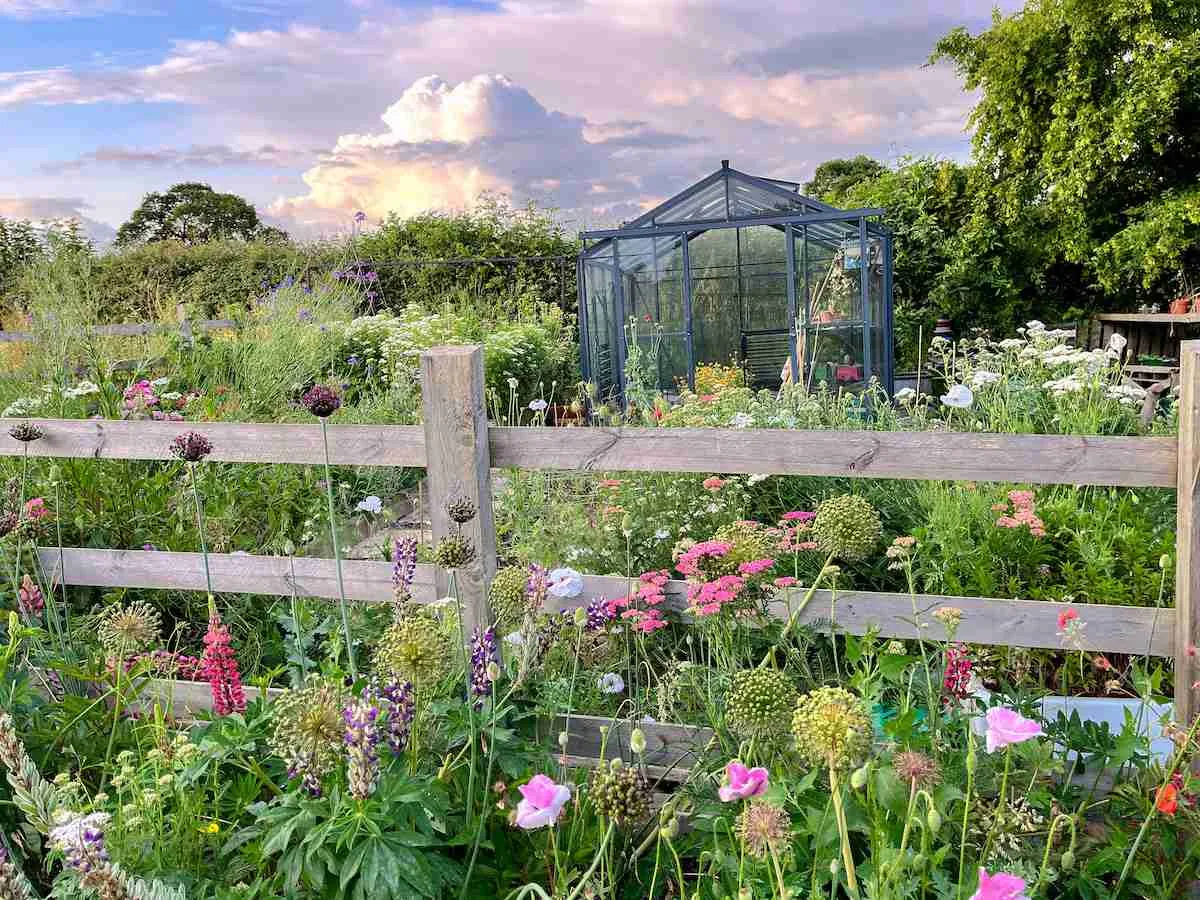
Start with the result – and let that shape the space
The cutting garden you need is the point where plants, preferences and reality come into play.
Because size and layout aren’t decided in isolation. They’re shaped by the kinds of flowers you love to grow – and how those flowers behave.
If you’ve been drawn to a particular arrangement, bouquet style or seasonal look, it’s worth pausing to unpack it a little:
- Are the flowers mostly cut-and-come-again, or are they one-cut wonders?
- Do they flower for months, or just a short window?
- Are they generous with stems, or do they take up a lot of space for relatively little return?
Some plants quietly limit how much you can harvest, no matter how carefully you plan. Peonies (and dare I say it, Dahlias) for example, need space and time before they repay you. Other plants – cosmos, zinnias, scabious, ammi – earn their keep quickly and repeatedly all season long.
This is why two gardens of the same size can produce very different results.
Layout, then, becomes less about squeezing plants in and more about choosing combinations that work with your space, your time and what you want to cut.
If you want plenty of flowers without turning gardening into a second job, The Flower Files might be just what you need.
Dedicated patch or dotted through the garden?
Here’s the honest truth: a dedicated cutting patch is easier.
Not because it’s more productive – but because it gives you permission.
When flowers live in their own space, you don’t hesitate. You cut freely. You don’t worry about gaps or things looking ‘tidy’. The whole patch exists to be harvested.
That said – if you don’t have the space, you are absolutely allowed to grow cut flowers among your existing plants.
The only rule is this:
You have to let yourself cut them.
Whether they’re in a raised bed, a border or a large pot, they only become cut flowers once you decide they are.
How much space is enough?
For most home growers, a cutting area of around 3m x 3m is comfortably sufficient for regular summer bouquets.
It doesn’t need to be one neat square. It can be broken into smaller beds or even spread across the garden.
But here’s the more reassuring part:
You can begin with far less.
A patch as small as 2m x 1m is enough to get going, especially if:
- You grow cut‑and‑come‑again flowers
- You’re happy with smaller, or more infrequent, pickings
- You supplement with foliage or perennials elsewhere in the garden
More space simply buys you margin – a little breathing room when things don’t go to plan (and they won’t, because it’s gardening).
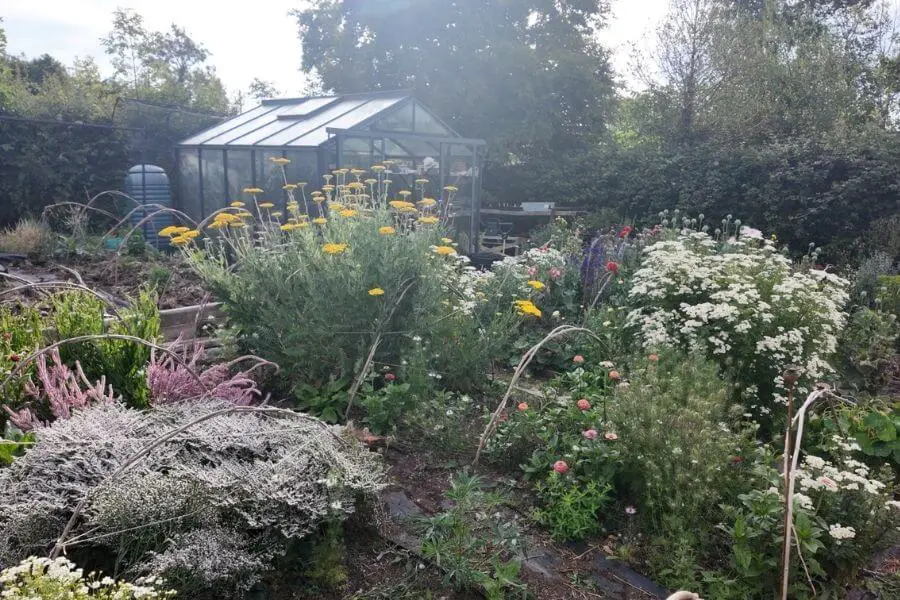
Annuals now, perennials for later
This is something I’m only just fully appreciating myself.
Perennials are a genuinely realistic option for cut flowers – and a very appealing one.
Rachel Siegfried’s The Cut Flower Sourcebook: Exceptional Perennials and Woody Plants for Cutting is a beautiful reminder that flowers don’t have to be resown every year to be generous. Many perennials offer:
- Reliable returns once established
- Second flushes after cutting (think delphiniums, achillea, feverfew)
- Structure and foliage as well as flowers
I’m increasingly drawn to dedicating more of my cutting space to them.
That said – perennials are a long game.
If you want flowers this summer, you still need space for annuals while the perennials settle in. A mixed approach is often the most forgiving:
- Annuals for abundance now
- Perennials quietly building for the future
Choose plants that earn their space
When space is limited, versatility matters.
Some of the hardest‑working plants in a cutting garden are the ones that do more than one job:
- Dual purpose plants – plants that provide more than just flowers, such as structure and greenery, can really earn their place
- Cut‑and‑come‑again annuals – endless stems from a single sowing
- Repeat‑flowering perennials – a second act if you cut them back
One plant, multiple uses. Less pressure. More flowers.
A gentle word on numbers
You can calculate stems, spacing and succession down to the square metre – and those calculations can be helpful.
But they’re only ever estimates.
What matters more is rhythm:
- Enough plants that you’re not stripping them bare
- Enough variety that everything doesn’t peak at once
- Enough space that tending and cutting still feels enjoyable
If you’re regularly harvesting little and often, you’re doing it right.
Finding your version of enough
A cutting garden doesn’t have to be big, perfect or impressive to be deeply satisfying.
It just needs to fit into your life – and your summer.
Start with what you want to see on the table. Give yourself permission to cut. Choose plants that keep showing up for you.
That’s more than enough.
Where to go next
If you’d like a little help choosing colour and combinations through the season, you might enjoy the Seasonal Colour Inspiration. Or, if you’re still at the very beginning, Where to Begin Growing Cut Flowers will help you decide your first, simplest steps. Both can be found in the Flower Files, my free resource library of all things cut flowers.
Both are there to make this feel lighter – not bigger.
Learn more about how to start and grow a cut flower garden in this series of blog posts:
- The 9 Benefits of Starting a Cutting Garden
- How to Start a Cut Flower Garden – 7 easy steps
- What’s the Best Cutting Garden Layout: How Much Space Do You Need?
- The Tools You Need to Create a Cut Flower Garden
- Cutting Garden Plan: What Makes a Good Cut Flower Garden
- When to Start a Cut Flower Garden For Beginners
- How to Grow Flowers For Cutting: Flower Bed Maintenance
- Flower Bed Maintenance: A Guide To Watering
And if you want to do it with the minimum of trouble find out the mistakes I made in starting my flower patch.
A quick aside: I built a little app for flower growers who want gentle reminders about what to do and when - without it turning into another thing to feel guilty about. It's called the Flower Grower Companion. You tell it your location and your flowers, it tells you what actually needs doing this week (and just as importantly, when there's nothing to do at all)
Have a look